
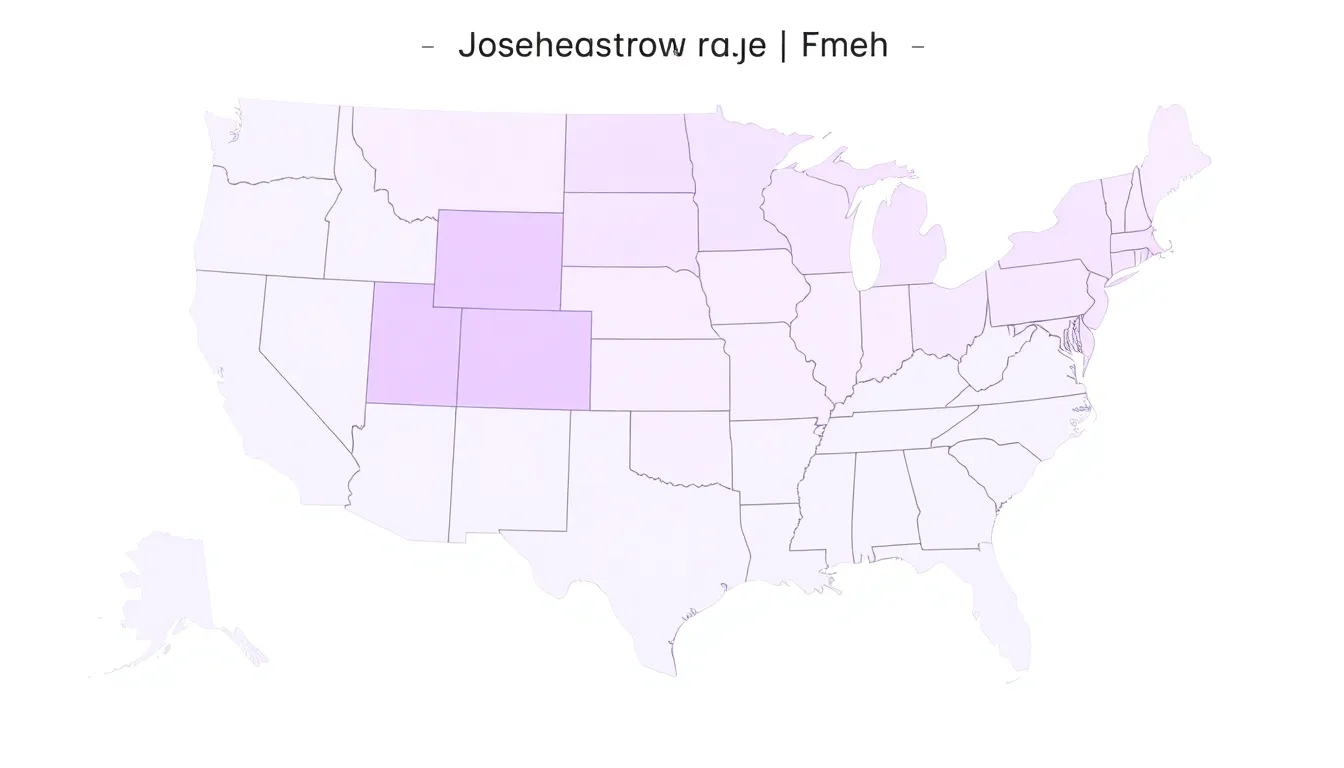
Depression doesn’t affect every part of the country equally. While the national average hovers around 8.4% of adults experiencing a major depressive episode in any given year, some states see rates nearly double that — while others fall well below.
These disparities aren’t random. They’re driven by measurable factors: access to mental health providers, poverty rates, insurance coverage, urban vs. rural composition, and cultural attitudes toward seeking help. Understanding what’s behind the numbers is the first step toward addressing them.
This article examines the states with the highest depression prevalence, the factors driving those numbers, and the states making progress — all backed by data from our comprehensive depression statistics database and federal survey data.
The 10 States With the Highest Depression Rates
According to SAMHSA’s National Survey on Drug Use and Health (NSDUH) and supplementary state-level data, the states with the highest rates of major depressive episodes among adults consistently include (SAMHSA, 2024):
-
West Virginia — Consistently ranks #1 or #2 nationally. The state faces a convergence of risk factors: high poverty, limited provider access, opioid epidemic, and aging population.
-
Oregon — Despite progressive mental health policies, Oregon struggles with provider shortages, homelessness, and high rates of substance use co-occurring with depression.
-
Kentucky — Rural healthcare deserts, high poverty, and opioid-related trauma drive elevated depression rates. Kentucky mental health statistics show the state consistently above the national average.
-
Arkansas — Among the lowest per-capita spending on mental health services in the country, with limited Medicaid expansion until recently.
-
Tennessee — Provider shortages in rural areas, combined with high rates of adverse childhood experiences and substance use.
-
Alabama — Limited mental health infrastructure, cultural stigma around seeking help, and economic disadvantage.
-
Mississippi — The lowest per-capita income in the nation combines with the fewest mental health providers per capita to create a severe access gap.
-
Maine — Despite overall high healthcare quality, Maine’s rural northern regions face severe provider shortages and isolation.
-
Vermont — High depression rates despite strong healthcare systems — possibly reflecting better screening and diagnosis rather than truly higher prevalence.
-
Utah — A notable outlier: relatively affluent with good healthcare access, but cultural factors and altitude have been studied as potential contributors.
The pattern is clear: states with the highest depression rates tend to share a combination of poverty, provider shortages, rural geography, and co-occurring substance use crises.
What Factors Drive State-Level Differences
Depression prevalence isn’t determined by a single factor. It’s the interaction of multiple variables:
Provider availability
The most direct driver. States with fewer psychiatrists, psychologists, and licensed counselors per capita consistently show higher rates of untreated depression — which in turn drives up overall prevalence. The Health Resources and Services Administration (HRSA) designates Mental Health Professional Shortage Areas (MHPSAs); states like Mississippi, Alabama, and West Virginia have the most extensive shortage designations.
Economic factors
Poverty and depression have a bidirectional relationship. Financial stress triggers depression, and depression impairs the ability to work and earn. States with higher poverty rates, lower median incomes, and higher unemployment consistently show elevated depression prevalence.
Low-income communities face compounded risk: higher stress, fewer resources, less insurance coverage, and greater exposure to adverse childhood experiences — all of which increase depression vulnerability.
Insurance coverage
States that expanded Medicaid under the Affordable Care Act saw measurable increases in mental health treatment utilization. States that didn’t expand — many of which already had high depression rates — continued to see large uninsured populations unable to access care.
Urban vs. rural composition
Rural populations face higher barriers to mental health care: fewer providers, longer travel distances, less anonymity (stigma concern in small communities), and limited telehealth infrastructure. States with large rural populations — West Virginia, Mississippi, Arkansas, Maine — consistently rank highest for depression.
Substance use co-occurrence
States hit hardest by the opioid epidemic also tend to have high depression rates. This isn’t coincidental — depression and substance use disorders frequently co-occur, each worsening the other. West Virginia, Kentucky, and Tennessee illustrate this pattern clearly.
Screening and diagnosis rates
An important caveat: states with better healthcare systems and more providers may actually detect more depression. Vermont and Oregon, despite high reported rates, may reflect superior screening rather than genuinely worse mental health. States with fewer providers may have artificially low rates because depression goes undiagnosed.
Access to Care: The Provider Shortage Map
The mental health provider shortage is national, but its severity varies dramatically:
- Massachusetts: ~300 mental health providers per 100,000 residents
- Alabama: ~100 mental health providers per 100,000 residents
- National average: ~200 per 100,000
The NIMH reports that over half of adults with mental illness do not receive treatment nationally, but this figure exceeds 60% in states with the worst provider ratios (NIMH, 2024).
Telehealth has partially addressed geographic access barriers. Since 2020, teletherapy utilization has increased dramatically, and states that maintained COVID-era telehealth flexibilities have seen improved access in rural areas. However, telehealth requires reliable internet — which many rural areas still lack.
Economic Factors: Poverty, Unemployment, and Depression
The correlation between state-level poverty and depression rates is among the strongest predictors in public health:
- States in the bottom quintile for median household income have depression rates 25–40% above the national average
- Unemployment spikes — such as those during the 2008 recession and 2020 pandemic — produced measurable increases in depression diagnoses in affected regions
- Cost of treatment remains the #1 barrier to mental health care nationally. In states without Medicaid expansion, low-income adults fall into a coverage gap where they earn too much for Medicaid but too little for marketplace subsidies
The WHO’s framework on social determinants of mental health identifies economic instability as a root cause, not just a correlate, of depression (WHO, 2024). Addressing depression at the state level requires addressing the economic conditions that drive it.
Rural vs. Urban: The Geography of Mental Health
The rural-urban divide in mental health care is stark:
Rural challenges:
- Fewer than 50% of rural counties have a practicing psychiatrist
- Average travel time to a mental health provider in rural areas: 45+ minutes
- Cultural norms in many rural communities stigmatize mental health treatment
- Agricultural and extraction-industry workers face seasonal depression, isolation, and occupational stress
- Suicide rates are consistently higher in rural areas than urban ones
Urban advantages and challenges:
- More providers per capita, shorter wait times, greater anonymity
- But urban areas face their own stressors: cost of living, overcrowding, noise, social isolation despite density
- Homeless populations concentrated in cities face extremely high depression rates
California depression data illustrates the urban-rural contrast within a single state — coastal urban centers have dramatically better access than Central Valley and northern rural counties.
States Making Progress: Success Stories
Not all the news is bad. Several states have made measurable progress:
Colorado: Invested heavily in integrated behavioral health, embedding mental health providers in primary care settings across the state. Depression screening rates increased significantly.
Connecticut: Early Medicaid expansion and investment in community mental health centers produced measurable improvements in treatment access.
Minnesota: Minnesota mental health statistics reflect the state’s investment in school-based mental health services and a robust mental health parity enforcement program.
Virginia: Recent Medicaid expansion and increased state mental health funding have begun to close the treatment gap, particularly in rural southwestern Virginia.
Common threads in successful states: Medicaid expansion, investment in workforce development (training more providers), integration of mental health into primary care, and school-based mental health programs.
How to Use This Data
State-level depression data serves multiple purposes:
For individuals: Understanding your state’s mental health landscape helps you anticipate barriers and plan around them. If you’re in a high-rate, low-access state, telehealth and out-of-state virtual providers may be your best option.
For employers: Companies with distributed workforces should recognize that employees in different states face different mental health landscapes. EAP utilization campaigns may need to be more aggressive in states with fewer community resources.
For advocates: State-level data makes the case for policy change. When you can show that your state ranks 45th in provider availability and 5th in depression prevalence, the argument for increased mental health funding writes itself.
For researchers: State variation creates natural experiments that help identify what works. Comparing states that expanded Medicaid to those that didn’t, for example, has produced some of the strongest evidence for the link between insurance coverage and mental health outcomes.
Explore our state-by-state data: Texas depression statistics, West Virginia, Oregon, and all 50 states are available with detailed breakdowns.
For a deeper look at the systemic issues behind these numbers, see our analysis of the national mental health treatment gap.
Frequently Asked Questions
What state has the highest depression rate?
West Virginia consistently ranks as the state with the highest depression rate, driven by a combination of high poverty, limited mental health provider availability, the opioid epidemic, and a predominantly rural population. However, rankings fluctuate annually, and states like Oregon, Kentucky, and Arkansas regularly appear in the top five.
Why do some states have higher depression rates than others?
State-level depression rates are driven by the interaction of multiple factors: access to mental health providers (the strongest predictor), poverty and economic stress, insurance coverage (particularly Medicaid expansion), urban vs. rural composition, substance use co-occurrence, and cultural attitudes toward seeking help. No single factor explains the variation — it’s always a combination.
Does living in a rural area increase depression risk?
Rural living itself doesn’t cause depression, but the access barriers associated with rural areas significantly increase the risk of untreated depression. Fewer providers, longer travel distances, cultural stigma, isolation, and occupational stressors all contribute. Suicide rates are consistently higher in rural areas than urban ones, partly reflecting untreated depression. Telehealth has helped but hasn’t eliminated the rural access gap.
Are states with high depression rates spending less on mental health?
Generally, yes. There is a correlation between per-capita state mental health spending and depression outcomes. States like Mississippi and Alabama, which spend the least per capita on mental health services, tend to have higher depression rates and worse treatment access. However, the relationship isn’t perfectly linear — some high-spending states still face challenges, and increased spending alone doesn’t solve structural issues like provider shortages.
Has any state successfully reduced its depression rate?
Several states have made measurable progress through policy interventions. States that expanded Medicaid saw increased mental health treatment utilization. States that invested in integrated behavioral health (embedding mental health in primary care), school-based mental health services, and provider workforce development have shown improvements in screening rates and treatment access. However, reducing population-level depression rates is a long-term effort — most improvements are measured in treatment access and utilization rather than prevalence reduction.
Sources
-
Substance Abuse and Mental Health Services Administration. 2024 NSDUH releases. SAMHSA; 2024. https://www.samhsa.gov/data/data-we-collect/nsduh-national-survey-drug-use-and-health/national-releases/2024
-
National Institute of Mental Health. Mental illness statistics. NIMH; 2024. https://www.nimh.nih.gov/health/statistics/mental-illness
-
Centers for Disease Control and Prevention. Data and statistics on children’s mental health. CDC; 2024. https://www.cdc.gov/children-mental-health/data-research/index.html
-
National Alliance on Mental Illness. Mental health by the numbers. NAMI; 2024. https://www.nami.org/mental-health-by-the-numbers/
-
World Health Organization. Mental health: strengthening our response. WHO; 2024. https://www.who.int/news-room/fact-sheets/detail/mental-health-strengthening-our-response
-
Patel V, et al. Understanding and addressing the treatment gap in mental healthcare. PMC; 2020. https://pmc.ncbi.nlm.nih.gov/articles/PMC7517998/
-
Substance Abuse and Mental Health Services Administration. Mental health treatment — how does it work? SAMHSA; 2024. https://www.samhsa.gov/mental-health/serious-mental-illness/treatment-works
-
National Institute of Mental Health. Help for mental illnesses. NIMH; 2024. https://www.nimh.nih.gov/health/find-help